 |
||||||||||||||||
|















|
|
 |
|
This tool is used on flat smooth stone surfaces. The flat blade rests entirely on the stone, held vertically by the stone cutter. It is struck with a hand hammer. The tool would be moved along the line to be cut and retraced along this line until the break occurred. Hand tools, as shown above, would have been used for dimensions of granite or other hard stone up to eight inches. This method would break the stone down to the size desired generally within one inch or less. A hand chipper would then be used to finish the edge.
Source: Melissa Kling Phillips, Kling Memorials/Butler Monument Co. Butler, Mo. |
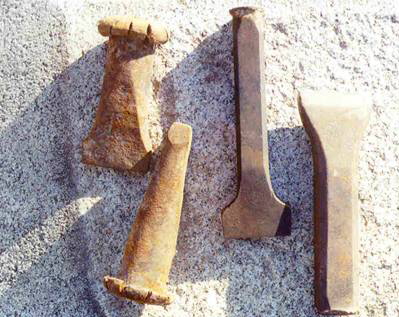 These pitching tools are also known as hand sets. The oldest, on the left, were hand forged by blacksmiths. They have been heavily worked as evidenced by their short length. Later, machined tools (center) became available which needed to be sharpened. Much later, a section of tungsten carbide (right) was inserted into the body providing extra strength and durability.
 |
|
| [Home] [Tools] [Hand Tools] [Pitching Tool] |